English Version:
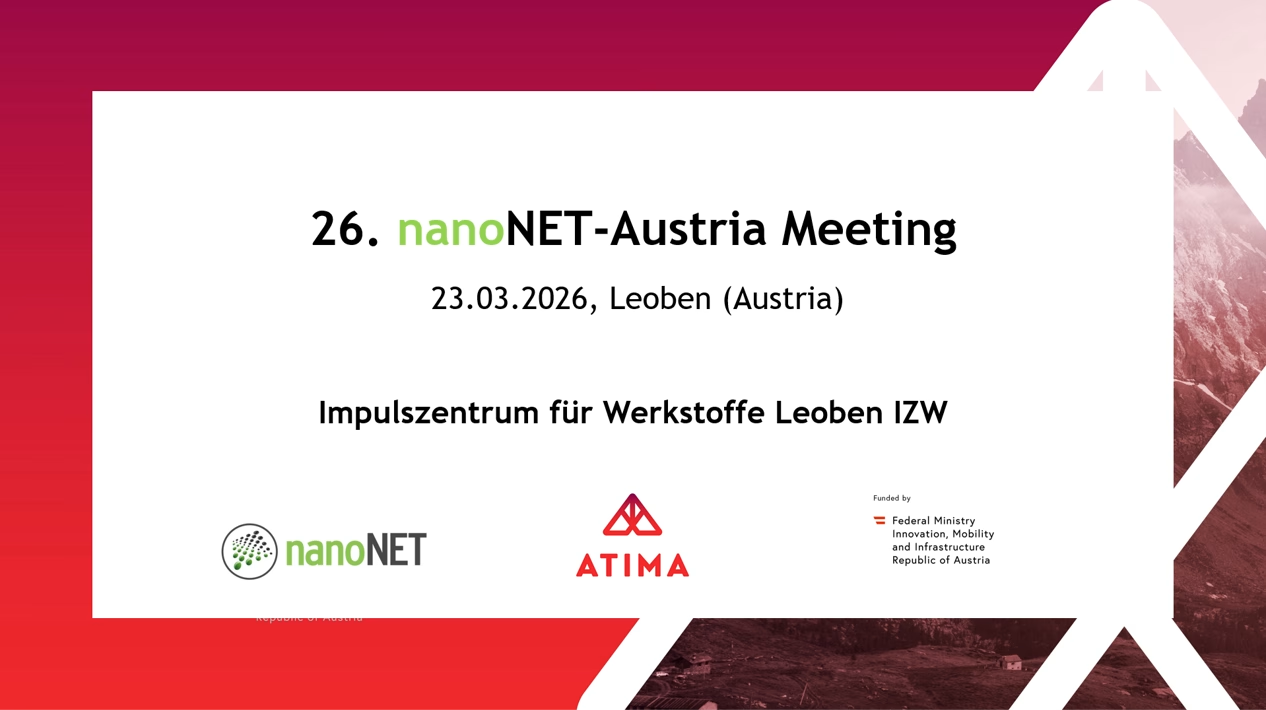
The 26th nanoNET-Austria Meeting took place on March 23rd at the premises of the Montanuniversität Leoben, which kindly hosted the event.
At the beginning of the meeting, Mag. Alexander Pogany presented current topics and activities of the Federal Ministry for Innovation, Mobility and Infrastructure (BMIMI) in the field of production technologies. Prof. Dr. Joachim Krenn from the University of Graz introduced his research in nano-optics involving plasmons and quantum dots. Dr. Larissa Egger from the Materials Center Leoben (MCL) then presented the innovative application of tailored nanomaterials for selective gas sensing. Building on this work, Dr. Maxim Popov, also from MCL, introduced methods for active-learning loops in gas sensor optimization.
This was followed by an insightful presentation on Nanoimprint Lithography: Small Structures, Big Possibilities by Dr. Elisabeth Rossegger from the Polymer Competence Center Leoben (PCCL). Subsequently, Dr. Michael Reisinger from KAI Kompetenzzentrum Automobil- und Industrieelektronik GmbH presented the role of nanostructures in modern power semiconductors.
Dr. Rudolf Heer from nanoNET-Austria and Silicon Austria Labs GmbH provided an update on activities within the network and gave an overview of upcoming events as well as presentations at international trade fairs.
The meeting concluded with guided tours of the Materials Center Leoben (MCL) laboratories, led by Dr. Larissa Egger and Dr. Maxim Popov.
The support from the FFG project ATIMA enables nanoNET-Austria to reach a broader audience within the nano community, extending beyond the circle of nanoNET-Austria members and interested parties.
Deusch Version:
Das 26. nanoNET-Austria Meeting fand am 23. März in den Räumlichkeiten der Montanuniversität in Leoben, die uns freundlicherweise eingeladen hat, statt.
Zu Beginn des Meetings präsentierte Mag. Alexander Pogany aktuelle Themen und Aktivitäten von Seiten des BMIMI, Bundesministerium für Innovation, Mobilität und Infrastruktur, auf dem Gebiet der Produktionstechnologien. Prof. Dr. Joachim Krenn von der Universität Graz stellte uns seine Forschung in der Nanooptik mit Plasmonen und Quantendots vor. Dr. Larissa Egger vom Materials Center Leoben (MCL) präsentierte danach die innovative Anwendung von Tailored Nanomaterials for Selective Gas Sensing. Dr. Maxim Popov, ebenfalls vom MCL setzte auf diese Arbeiten auf und stellte uns Methoden für Active-Learning Loop for gas sensor optimization vor.
Danach folgte eine Einblick in Nanoimprint Lithography: Small Structures, Big Possibilities durch Dr. Elisabeth Rossegger vom Polymer Competence Center Leoben (PCCL). Im Anschluss präsentierte Dr. Michael Reisinger vom KAI Kompetenzzentrum Automobil- und Industrieelektronik GmbH die Rolle von Nano structures in modern power semiconductors.
Dr. Rudolf Heer von nanoNET-Austria und Silicon Austria Labs GmbH berichtet aus dem Netzwerk und gibt einen Überblick zu Veranstaltungen und Präsentationen auf internationalen Messen.
Im Anschluss leiteten Dr. Larissa Egger und Dr. Maxim Popov Führungen durch die Labors vom Materials Center Leoben (MCL).
Die Unterstützung druch das FFG-Projekt ATIMA ermöglicht uns ein über den Kreis der Mitglieder, Interessentinnen und Interessenten von nanoNET-Austria hinaus gehendes Publikum der Nano-Community zu erreichen.